Blog

  • Fossil Fuels Enable Us to Better Fight Fires and Other Environmental Disasters

    Connor Mortell – June 10, 2023

    This week we’ve seen a relatively unprecedented environmental phenomenon in New York City. Canadian wildfires have led to the worst air quality New York has ever had—and the worst air quality anywhere in the world right now. The air has taken on a sepia tint, and the city looks like the setting of a postapocalyptic movie.

    Many individuals are blaming the situation on climate change and calling for mass government intervention. Alexandria Ocasio-Cortez, for example, has used it to renew her call for a Green New Deal. This is an example of what Mises Institute fellow Joshua Mawhorter has referred to as the statist non sequitur: “The statist non sequitur involves the existence of a problem followed by the alleged solution of statism. It is typically put in the form of a statement or a loaded question presupposing the necessity of a ‘solution’ imposed by the state as the obvious and sole conclusion.”

    We must provide a better answer than the statist non sequitur.

    For this we can turn to perhaps the loudest voice in defense of fossil fuels, Alex Epstein. Fossil fuels are routinely attacked for their alleged cause of extreme climate events like this wildfire-induced haze. However, Epstein has argued in his book Fossil Future: Why Global Human Flourishing Requires More Oil, Coal, and Natural Gas—Not Less that even conceding the most radical anti–fossil fuel claims regarding global warming, fossil fuels are still a benefit to society. “Even if we concede fossil fuels have caused global warming,” he asks, “how have climate related deaths trended since the proliferation of fossil fuels?” He replies:

    Over the last century, as CO2 emissions have most rapidly increased, the climate disaster death rate fell by an incredible 98 percent. That means the average person is fifty times less likely to die of a climate-related cause than they were in the 1920s. . . .

    A dramatic reduction in climate-related death has to be the result of at least one of two factors: (1) an improvement in the state of climate conditions and/or (2) an improvement in the state of our ability to protect ourselves from climate. . . .

    The dramatic change has to be an improvement in our ability to protect ourselves from climate dangers such as extreme temperatures, drought, storms, floods, and wildfires.

    How have we gotten so good at protecting ourselves from climate?

    In large part by using fossil-fueled machine labor.

    We use fossil-fueled construction machines to build sturdy buildings. We use fossil-fueled heating machines to produce warmth when it’s cold and fossil-fueled cooling machines to produce cool air when it’s hot. We use fossil-fueled irrigation machines to alleviate drought.

    To put the relationship between fossil fuels and our safety from climate in a sentence: ultra-cost-effective fossil fuel energy powers the machines that produce unprecedented protection from climate.

    Epstein demonstrates that even if fossil fuels create climate change and cause significantly worse climate conditions, the vast technological benefits of fossil fuels have been so overwhelming that there have been fifty times fewer climate deaths than there were one hundred years ago. Therefore, human flourishing is stronger thanks to the effects of fossil fuels.

    With these facts in mind, what is the best way to deal with forest fires? Epstein explains that there are three ways to fight wildfires—reducing fuel load, building fire barriers, and intelligently fighting fires—and that all of them are more effective with the help of fossil fuel–powered machinery.

    Fuel load reduction consists of intentionally scorching fire-prone areas to remove potential wildfire fuel (such as dead trees and leaves) before it piles up enough to feed a forest fire. These controlled burns used to be done regularly in western US forests until the US Forest Service and environmentalists put a stop to them. Epstein thinks we should reimplement fuel load reduction, writing:

    Today we have the ability to use fossil-fueled machines to do far more targeted controlled burns by creating firebreaks to prevent uncontrolled spread, planning the exact area to be burned, and assessing success with satellite imagery or via airplane. In addition to controlled burns, we can use fossil-fueled machine labor to do logging, in which case we actually convert the wood that could cause wildfire into wealth. We can also do mechanical brush clearing, using tractors with mulchers and other equipment attached.

    Fire barriers are another great way to control forest fires. The same fossil fuel–burning engines that now allow us to better execute controlled burns also allow us to build larger, stronger fire barriers “between forests and people—or, if desired, between one area of forest and another.”

    The last resort in controlling wildfires is of course firefighting, and this has also been improved by fossil fuels. As Epstein explains, “We use fossil-fueled machines and fossil fuel materials to fight fires when they start. We use high-energy fossil-fueled machines, like trucks and aircraft for transporting water, and flame-resistant, oil derived materials such as Nomex to protect firefighters.”

    Every method of fighting fires—and thus for protecting against their wide ripple effects, like hazardous air quality—has been vastly improved by fossil fuels. Those calling for political action against fossil fuel use are therefore calling for more wildfire destruction, not less.

    Originally published at Mises.org.  

    Image source: Adobe Stock

  • There Is No Moral Right to Strike

    Gary Galles – June 6, 2023

    Americans are in a time of rising labor unrest and activism, including multiple unionization campaigns, regulatory and legal changes to make it easier for unionization efforts to succeed, the “Fight for $15” minimum wage agitation, and the Hollywood writer’s strike. However, such discussions and campaigns seldom approach the issues involved from a moral perspective, beyond the implicit presumption that trying to force others to give you a raise must be moral.

    That is why it is worth reconsidering Leonard Read’s bold argument that “There Is No Moral Right to Strike” in his The Coming Aristocracy (1969): “Rarely challenged is the right to strike. While nearly everyone in the population, including the strikers themselves, will acknowledge the inconvenience and dangers of strikes, few will question the right-to-strike concept.”

    A quick Google search of “union strike” or “right to strike” quotes quickly verifies Read’s premise that the right to strike is broadly accepted. However, most discussions of strikes focus on their legality, rather than their morality. Read states that “The present laws of the United States recognize the right to strike; it is legal to strike. However, as in the case of many other legal actions, it is impossible to find moral sanction for strikes in any creditable ethical or moral code.”

    That conclusion is dramatically at odds with one particular quote I came across in the search mentioned above that asserted that “The right to strike is a fundamental human right.”

    Almost as if he was responding directly to that claim, Leonard Read focused on what he saw as the major source of confusion behind it—the difference between the right to quit, singly or as a group, and the right to strike, which goes much further:

    This is not to question the moral right of a worker to quit a job or the right of any number of workers to quit in unison. Quitting is not striking, unless force or the threat of force is used to keep others from filling the jobs vacated. The essence of the strike, then, is the resort to coercion to force unwilling exchange or to inhibit willing exchange. No person, nor any combination of persons, has a moral right to force themselves—at their price—on any employer, or to forcibly preclude his hiring others.

    Read, for whom the distinction between willing and unwilling exchange was a major theme, recognized that the right to quit involved no coercion of others and violated no one else’s equal rights to offer their labor or goods and services in willing exchanges. However, strikes relied on coercion, allowing strikers to violate others’ equal rights: “Reference need not be confined to moral and ethical codes to support the conclusion that there is no moral right to strike. Nearly anyone’s sense of justice will render the same verdict if an employer-employee relationship, devoid of emotional background, be examined.”

    As he so often did, Read turned to an illustrative example to make his point:

    An individual with an ailment employs a physician to heal him. The physician has a job on agreeable terms. Our sense of justice suggests that either the patient or the physician is morally warranted in quitting this employer-employee relationship at will, provided that there be no violation of contract. Now, assume that the physician (the employee) goes on strike. His ultimatum: “You pay me twice the fee I am now getting or I quit! Moreover, I shall use force to prevent any other physician from attending to your ailment. Meet my demands or do without medical care from now on.”

    Who will claim that the physician is within his moral rights when taking an action such as this?

    Read then generalized the moral conclusion of his example in contrast to the common “right to strike” view:

    To say that one believes in the right to strike is comparable to saying that one endorses monopoly power to exclude business competitors; it is saying, in effect, that government-like control is preferable to voluntary exchange between buyers and sellers, each of whom is free to accept or reject the other’s best offer. In other words, to sanction a right to strike is to declare that might makes right—which is to reject the only foundation upon which civilization can stand.

    To further develop his argument, Read turns to a property rights approach, reflecting economists’ understanding that different property rights provide different incentives, and different incentives produce different outcomes. In particular, he emphasizes that a job is the result of a willing exchange between parties, not something a worker “owns” in the absence of contractual agreement or continued willingness by the employer. However, a right to strike asserts not just ongoing ownership of one’s current job even in the absence of employer agreement, but a new right they did not have when they entered their employment relationship—the ability to deny all others the right to compete for that job, even if both that worker and the employer would agree to it:

    Lying deep at the root of the strike is the persistent notion that an employee has a right to continue an engagement once he has begun it, as if the engagement were his own piece of property. The notion is readily exposed as false . . . A job is but an exchange affair, having existence only during the life of the exchange. It ceases to exist the moment either party quits or the contract ends. The right to a job that has been quit is no more valid than the right to a job that has never been held.

    Leonard Read concludes that “the censure” for the adverse consequences for individuals’ rights and social cooperation that arises from both threatened and imposed strikes “should be directed at the false idea that there is a moral right to strike.”

    It is worth noticing that Leonard Read’s argument here is also strongly aligned with one of his libertarian forebears—English philosopher Auberon Herbert. Like Read, Herbert believed in a government solely empowered to use defensive force against others’ aggressive use of force so that “the state would defend the rights of liberty, never aggress upon them.” In his 1891 “The True Line of Deliverance,” Herbert stated:

    It is the interest of all . . . to make the free-trade footing universal for all. I do not mean that A and B should accept work on any terms other than those that they themselves approve; but that they should throw no dam round their labor by preventing C from . . . accepting terms which they decline. That is the true labour principle, universal individual choice . . .

    . . . the labor of the country never can obtain for itself, except at the expense of other labour, more than the free and open market will yield. . . . Extracting more . . . is very near to dishonesty, since he is forcing this higher price at the expense of others. . . .

    . . . leave every man free to settle his own price of labour . . . In the case of a serious disagreement between an employer and his men, the union would remove all such men as wished to leave . . . But there would be no effort to prevent the employer obtaining new hands. . . . There would be no strike, no picketing, no coercion of other men, no stigmatizing another fellow-workman . . . because he was ready to take a lower wage—all this would be left perfectly free for each man to do according to what was right in his own judgment. If the employer had behaved badly, the true penalty would fall upon him; those who wished to leave his service would do so . . . That would be at once the true penalty and the true remedy. Further than that in labour disputes has no man a right to go. He can throw up his own work, but he has no right to prevent others accepting that work.

    Leonard Read, and Auberon Herbert before him, stood apart from “the crowd” in that both approached the right to strike from a moral perspective. They shared a common answer to the animating question, “Do you believe in force and authority, or do you believe in liberty?” They came to similar conclusions. In fact, Read could easily have written Herbert’s thoughts about the right to strike’s use of coercion to violate others’ rights—“Force rests on no moral foundations.”

    Originally published at Mises.org. Gary M. Galles is a Professor of Economics at Pepperdine University and an adjunct scholar at the Ludwig von Mises Institute. He is also a research fellow at the Independent Institute, a member of the Foundation for Economic Education faculty network, and a member of the Heartland Institute Board of Policy Advisors.

    Image source: Adobe Stock

  • “Trans Rights” Means Trans Entitlements and the End of Civil Society

    Wendy McElroy – May 31, 2023

    A “civil society” is a community of individuals who are linked together by common interests and activities. Common interests include being able to walk the streets safely (peace) and to exercise such rights as freedom of speech (individual freedom). These shared interests allow common activities to flourish, including commerce and the education of children.

    Civil society is possible only because most people want to live securely, protect their loved ones, and prosper. This laissez-faire attitude used to be a defining characteristic of Americans, but an engineered and well-financed cultural war is destroying America’s renowned tolerance. If the common interests of society break down and peace and freedom are replaced by violence and privilege, then common activities like free-market commerce and education cannot function.

    One movement captures the raw destruction of this culture war against civil society—a demand for “Trans rights!” blasts across America. But a sharp backlash against it has also developed, epitomized by the boycott of Bud Light beer over the company’s use of trans activist Dylan Mulvaney as a new “woman” ambassador for its brand.

    The media characterizes this backlash as anti-trans hatred by conservatives, Christians, and other troglodytes. But few people care about the sexual or gender orientation of their neighbors. Critics of the trans movement are rebelling against the forced redefinition of biology, the destruction of women’s sports by trans athletes, the hijacking of children’s education, the medical experiment of gender-transitioning children, and the intrusion of penises in women-only spaces like bathrooms, locker rooms, prisons, and shelters. Critics don’t want to oppress anyone; they want a return to civil society of peace and individual rights.

    To understand why the “trans rights” movement has caused such damage, it is necessary to ask three questions. What is a “transgendered” person? What are “rights”? What is produced by the actions the movement takes?

    What is a transgendered person? Already we’re in trouble. Many prominent intellectuals today can’t even answer the simpler question, What is a woman? This article uses a common definition: “Transgender describes people whose gender identity does not match their assigned gender at birth.” It is one of many gender categories being advanced by social justice. There are as many as eighty-one distinct categories, all of which are said to be fluid or constructed over time.

    Politically speaking, transgenderism and the other gender categories are a continuation of identity politics. This is a fairly standard definition of identity politics: “The politics of group-based movements claiming to represent the interests and identity of a particular group, rather than policy issues relating to all members of the community. The group identity may be based on ethnicity, class, religion, sex, sexuality, or other criteria” (emphasis added). It is an attempt to splinter society into groups and categories, all of which are at war with each other because their interests are said to conflict. What does this war look like?

    Consider a controversial example: gender transitioning. This is when a person uses reassignment therapy, hormone replacement, and sex reassignment surgery to change their birth sex. Few argue against the gender transition of adults who pay for the process themselves. But the trans movement demands the gender transitioning of children, often at taxpayer expense; that is, a tomboy might become a “boy” through methods that include irreversible surgery.

    There are at least two flash points here. One is the minimum age at which a person should transition. The World Professional Association for Transgender Health claims hormones can start at age fourteen and some surgeries at fifteen—in other words, at the height of a teenager’s sexual confusion. Recently, a licensed social worker at a children’s medical center in Austin, Texas, was reportedly recorded as saying the center provided gender modification to children as young as eight. On April 25, Senator Ted Cruz and Representative Chip Roy submitted a formal request to the center for information on how gender dysphoria is diagnosed, how federal dollars are spent in the process, and whether patients under eighteen underwent “experimental medical procedures.”

    The group war here is between a child’s right against physical abuse and trans activists’ demands for children’s access to transition. The other flash point is that transitions are often performed without parental consent or despite parental objections. The rights war here—trans activists are usurping traditional parental rights, and parents are outraged.

    The idea that the rights of one group conflict with those of another is perverse because it destroys the very basis of human rights. Human rights are universal because they are rooted in human nature. All human beings possess the same rights to the same degree. Rights are not based on secondary characteristics such as gender; they rest on a shared humanity. In other words, a trans person has the same rights to the same degree as every other person in society. No more, no less.

    The “rights” demanded by trans activists are actually entitlements or group privileges. This is made clear by the claim of historical oppression, which is used to justify many demands. What is really being claimed is victimhood, upon which their entitlements are based. For trans activists to sustain their victimhood status, however, those who oppose them must be cast as oppressors and endless haters. Conveniently, this characterization removes the need to deal with any argument the “haters” present, such as the need for real human rights.

    Again, this trans stance is a perversion. If the trans movement has been historically oppressed—and I do not argue against this—then the movement should value individual rights more than the average person. These freedoms are how an aggrieved individual rises to his or her feet. But trans activists do not want to be treated as equal individuals; they want to be a privileged group that imposes huge costs on the majority of society to their great benefit. Individual rights are an obstacle.

    Gender transition is one area in which civil society is being replaced with civil warfare, but there are many others:

    • Trans “women” housed in women-only venues, like prisons and shelters, put biological women there at risk of sexual assault. Rapes are already happening.
    • Trans curricula in American public schools indoctrinate children at the expense of teaching basic life skills, like math and literacy.
    • A prominent doctor on Fox News warned, “First-year medical students [are] exposed to woke ‘sex and gender primer’ lesson.” This shifts the focus away from medical problems; it could also damage relationships with patients who do not share woke ideology or are not in a privileged group. The same is happening in law schools.
    • The trans agenda violates constitutionally guaranteed freedom of speech in myriad ways, from forcing schools to use pronouns like “xe” and “hir” to shouting down speakers or violently attacking them.
    • Draconian hate speech laws are destroying meaningful public discourse. A new bill passing through the Irish parliament, for example, outlaws communication or the possession of material that might incite hatred against “protected” classes, including gender. This is punishable by up to five years in prison.
    • The demand to include trans athletes in women’s sports is destroying the entire field.
    • Transitioned children who deeply regret transitioning are generally silenced or dismissed.

    One way detransitioners are dismissed is through studies and statistics into which little trust can be invested. An article in the Associated Press claims, “In a review of 27 studies” of transgender surgeries, “1 percent on average expressed regret.” If this is true, it is good news. But is it true? The incessant ideology pumped through academia and the airwaves is yet another cost to civil society. Academics, journalists, and so-called experts have earned the public’s scorn. Studies and research have become just one more front in this war of all against all.

    The media and authorities richly deserve this summary judgment from the public. Consider how they handle acts of violence. Every act of violence against a trans person seems to be widely reported and condemned, as it should be. But trans violence against biological women or other outsiders seems to be ignored or excused. Even the trans shooter in Nashville who killed three nine-year-old school children and three adults is protected by authorities who refuse to release the shooter’s manifesto. And media reports often expressed more concern about a backlash against trans people than about the dead children. SAVE Services, an agency that works to assure due process and fairness in schools, has an interesting page called “Stop the Wave of Transgender Violence” where many cases of trans violence are documented. In this environment, it is simply not possible to know what’s true about the levels of violence and against whom.

    I would end by asking, can a more general violence—a savage civil unrest—be far behind? I believe it is already here.

    Originally published at Mises.org.  

    Image source: Adobe Stock

  • The Putrid Underbelly of Woke Capitalism

    Michael Rectenwald – May 30, 2023

    Corporate intrigue reached a fevered pitch on May 6, 2023, in Omaha, Nebraska, when a shareholder was arrested during the annual shareholder meeting of Berkshire Hathaway. The shareholder challenged the affiliation of Warren Buffett with the Bill and Melinda Gates Foundation and Bill Gates’s association with Jeffrey Epstein, who was convicted in Florida for procuring a child for prostitution and soliciting a prostitute, and who reportedly committed suicide in a New York jail while facing charges for sex trafficking and conspiracy to engage in sex trafficking.

    Peter Flaherty, the chairman of the National Legal and Policy Center (NLPC), stood to offer proposal number eight, which called for the roles of Berkshire CEO and chair to be separated and held by two persons. Flaherty argued that the separation of roles was necessary so that Berkshire “would be less identified with Mr. Buffett’s personal political activities.” Speaking of Buffett, Flaherty stated:

    He’s donated tens of billions to the Bill and Melinda Gates Foundation. As Bill Gates explained when the couple was still together, “although the foundation bears our names, basically half our resources have come from Warren Buffett.”

    If “woke” culture is a disease, then philanthropy is the virus.

    The Gates Foundation bankrolls the teaching of Critical Race Theory around the country, including that math is inherently racist.

    The Gates Foundation offers a Gender Identity Toolbox which asserts that gender is the result of “socially and culturally constructed ideas.”

    This is a lie. Gender is not a cultural construct. It is a genetic and biological fact. (emphasis mine)

    Flaherty was interrupted by a Berkshire representative and pleaded to the chair (Buffett) to be allowed to continue. Buffett agreed that Flaherty could continue but warned him of the three-minute time limit for shareholder proposals. Flaherty then proceeded to throw down the gauntlet, until his microphone was shut off:

    We know how much Bill Gates cares about children. He met and traveled with Jeffrey Epstein many times after Epstein was convicted of sex crimes.

    The Gates Foundation had a huge influence over the COVID response fiasco.

    Bill Gates defended China’s COVID policies and still discounts the possibility that the virus originated from a lab, even though U.S. intelligence agencies disagree. The Gates Foundation may be the largest single donor to the “dark money” machine known as Arabella Associates. . . .

    It funds causes like defunding the police that are making American cities unlivable.

    Money goes, too, to groups conducting—

    At this point, Buffett declared from the stage: “You crossed the boundary.” Two security guards grabbed Flaherty by either arm and escorted him from the room. Flaherty was arrested and charged with trespassing.

    The arrest of the Berkshire shareholder, apparently for merely mentioning Jeffrey Epstein in connection with Bill Gates and Warren Buffett, coincided with a series of Wall Street Journal articles exploring Epstein’s calendar and a trove of Epstein emails and other documents. The Wall Street Journal revealed numerous Epstein meetings with high-profile contacts, long after Epstein served time for soliciting a child prostitute and was registered as a sex offender. Represented in Epstein’s calendar and emails are such notables as William Burns, director of the Central Intelligence Agency since 2021; Bill Gates, Microsoft founder and philanthropist; Jess Staley, former Barclay’s CEO; Reid Hoffman, cofounder of LinkedIn; Larry Summers, professor and former Harvard University president; Woody Allen, filmmaker; and Noam Chomsky, leftist MIT linguistics professor, among others. These and other meetings may reveal that many businesspersons and woke philanthropists were ensnared by a child sex trafficker.

    The scene at the Berkshire annual meeting also followed on the heels of the lawsuit filed against JPMorgan Chase by the US Virgin Islands. Attorneys for the US Virgin Islands claim that the bank materially aided Epstein in his child sex trafficking scheme and is seeking damages for their clients. Four billionaires have been subpoenaed in the case so far, including Google cofounder Sergey Brin; Hyatt Hotels CEO Thomas Pritzker; real estate tycoon and owner of U.S. News and World Report Mortimer Zuckerman; and venture capitalist and Hollywood agent Michael Ovitz. Curiously, the US Virgin Islands has also attempted, without success, to serve a subpoena to Google’s other cofounder, Larry Page, whose whereabouts remain unknown and who obviously does not want to be found.

    It should be remembered here that Google has represented the leading edge of woke capitalism, with its leftist ranking algorithms and its employment of “machine learning fairness” that corrects for so-called algorithmic unfairness by misrepresenting reality with affirmative action results. Clearly, Google’s founders did not rely on algorithms to identify and eliminate pedophiles from their list of business contacts.

    While the US Virgin Islands asserts that JP Morgan Chase facilitated and possibly bankrolled Epstein’s pedophilia ring, US Republican lawmakers have claimed that the US’s largest bank has a penchant for cancelling the accounts of conservative and religious groups. The bank maintained its financial relationship with Epstein until 2013, long after he was convicted of sex crimes, yet recently cancelled the accounts of such groups as the National Committee for Religious Freedom. The bank’s touted “diversity and inclusion” policy has apparently included pedophiles but excluded avowedly Christian groups.

    Much more has and could be said about why high-profile businesspersons, philanthropists, academics, and even intelligence officers had relationships with Jeffrey Epstein. For example, some have claimed that Epstein and his partner Ghislaine Maxwell were Israeli spies who ran a honey-trap operation to steer US policies in Israel’s favor and against US interests.

    As the Wall Street Journal asked:

    Epstein was a former schoolteacher. How did he become a billionaire? What was the source of his wealth? Was he paid for providing women or girls to his friends? Was he a blackmailer? Were women or girls an enticement to invest in his projects?

    Finally, there’s the ridiculous, implausible matter of Epstein’s death in federal custody on Aug. 10, 2019, which 3½ years later remains under investigation by the Justice Department inspector general, only feeding conspiracy theories.

    But the main question for our purposes is: How is [it] that nearly all major corporate heads and influential members of society have simultaneously gone woke? Could it be that whoever controlled Jeffrey Epstein sets the agenda through the use of blackmail, directing these corporate heads and other leaders to convert to wokeness, while steering their philanthropy to designated ends, including the funding of critical race theory and the LGBTQIA+ agenda? In other words, is our capitalist class controlled by whoever oversaw Epstein’s thirty-year entrapment operation?

    In addition to revealing the moral rot that has permeated the US establishment, the Epstein connections also show that those who claim the woke moral high ground, and impose woke policies on the rest of us, are perhaps the most corrupted people on the face of the earth.

    Originally published at Mises.org. Michael Rectenwald is the author of twelve books, including The Great Reset and the Struggle for Liberty: Unraveling the Global Agenda, Thought Criminal, Beyond Woke, Google Archipelago, and Springtime for Snowflakes. He is a distinguished fellow at Hillsdale College.

  • The Bud Light Boycott and Clueless Corporate Executives

    Ryan McMaken – May 29, 2023

    In perhaps one of the most unexpected and sudden shifts in consumer demand in recent years, sales of Bud Light have now fallen sizably for six weeks in a row, with no end in sight. The New York Post reported on Monday that “Sales of the US’s No. 1 beer were down 24.6% for the week ended May 13 compared to a year ago — slightly worse than the 23.6% dip they suffered a week earlier.” 

    But it’s not just Bud Light. Sentiment has turned against Bud Light parent Anheuser-Busch Inbev (AB Inbev) to the point that other brands at the company are seeing declining sales as well. Budweiser, Michelob Ultra, Natural Light, and Busch Light all experienced declines during the same period. AB Inbev has lost an “astonishing” $15.7 billion in value over the past six weeks.

    Not surprisingly, Bud Light is also losing market share as former Bud Light consumers turn to competitors. Miller Light and Coors Light (both brewed by MolsonCoors) have seen a surge in sales as have independent brands Yuengling and Pabst Blue Ribbon. 

    Why have so many consumers changed their mind? It appears the shift stems from an ill-fated ad campaign initiated by Bud Light executives in an attempt to pander to “transgender” activists and their ideological allies. In early April, Bud Light promoted social media posts with transvestite Dylan Mulvaney—who claims to be a woman—as a spokesperson. The post featured a newly issued can featuring an image of Mulvaney in commemoration of Mulvaney’s alleged “365 days of girlhood.” 

    The response from many ordinary observers on Twitter was less than positive, with many denouncing AB Inbev for pushing a highly divisive politically charged ad campaign that many existing Bud Light drinkers found insulting. Several Conservative media outlets began to promote the boycott as well, and the boycott caught on among both well-known conservative pundits and among a larger number of users on social media platforms. Soon thereafter, sales of Bug Light began to fall quickly. The large numbers abandoning the brand, however, are too large to blame on just a small minority of right-wing political activists. Rather, Bud Light has apparently damaged its image with a large number of consumers, most of whom are likely uninterested in activism, but simply prefer a beer that is less political. 

    At first, it was unclear that the boycott would have any discernible effect, given the sheer number of other beer brands under the AB Inbev umbrella. However, it soon became clear that the company was feeling the pinch. Two Bud Light executives behind the Mulvaney campaign were put on a “leave of absence” (i.e., fired). The corporation launched new ad campaigns in an attempt to win back consumers who had apparently lost interest in the company’s products. These new ads were nostalgic and hyper “patriotic” in character, and were transparently devised to appeal to former core consumers. These efforts, however, were mocked as insincere in social media. 

    As the latest sales numbers suggest, however, these efforts have apparently not been working. A new report from Beer Business Daily concludes “We’ve never seen such a dramatic shift in national share in such a short period of time,” and that if the boycott continues, Bud Light risks losing its position as the nation’s best selling beer. 

    If Bud Light’s decline continues, it will be because company executives committed the most basic sin of entrepreneurship and marketing: they were apparently more interested in their own preferences rather than the preferences of their customers. 

    Where Did Bud Light Go Wrong? 

    Specifically, it seems likely that the Bud Light/Mulvaney campaign was an attempt on the part of corporate executives to cater to certain ideological groups—groups favored by wealthy, elite-college-educated managers—rather than to the company’s largely middle-class, middle-Americans customers. For example, the executive in charge of the campaign, Alissa Heinerscheid, attended a $60,000 per year private school (the Groton School) in her youth, and went on to get degrees in English and Literature from Harvard. She also obtained an MBA through the Wharton School. This is not someone who would naturally have any common cause or innate understanding of Bud Light’s customer base. 

    Denouncing the Bud Light’s current branding as “fratty” and “out of touch,” Heinerscheid decided that Bud Light should cease pursuing its existing clientele in favor of partnerships with transgender activists. There is no doubt that this idea would seem attractive to someone of Heinerschied’s background. Yet, it’s difficult to see how Bud Light could improve its financial situation by enthusiastically partnering with a highly divisive figure such as Mulvaney. 

    Bud Light is now learning the hard way that it’s the consumers—not corporate managers—who decide what goods and services get produced. At the heart of the entire economy is what Ludwig von Mises called the “sovereign consumer” whose unpredictable and subjective valuations ultimately determine all prices in the economy through consumer demands. Mises writes:

    Neither the entrepreneurs nor the farmers nor the capitalists determine what has to be produced. The consumers do that. If a businessman does not strictly obey the orders of the public as they are conveyed to him by the structure of market prices, he suffers losses, he goes bankrupt, and is thus removed from his eminent position at the helm. Other men who did better in satisfying the demand of the consumers replace him.

    Bud Light executives thought customers wanted the beer to partner with a “transgender” celebrity. Or executives simply didn’t care what customers thought. In any case, the executives are now paying the price. 

    Value Is Subjective—especially When It Comes to Light Beer

    The miscalculation on Bud’s part may prove to be especially damaging for two reasons. The first is that light beer is extremely dependent on emotional appeal to sustain brand loyalty. The other factor working against Bud Light is that it is extremely easy for consumers to switch to another brand. 

    All value is subjective to the consumer, of course, but some brands can at least hope to convince consumers of the brand’s value based on objective factors. For example, Volvo has long marketed itself—with studies to back up the claims—as a particularly safe automobile. Other brands are able to claim high levels of reliability, such as with Maytag appliances which used to be known for rarely needing repairs. 

    Needless to say, light beer can’t bank on these factors. Blind taste tests have shown that consumers can’t even distinguish between brands based on taste. As one researcher put it, light beer is essentially “a commodity industry.” This is why Coors Light began marketing itself not as the “most delicious” light beer, but as the “coldest,” complete with a special label that turns blue when the beer gets cold. When flavor doesn’t matter much, light beers have to look elsewhere to gain customer loyalty. 

    Because of this, it is highly likely that most consumers of light beer choose their beer “not for taste but because of the beer’s image and reputation that’s been developed via advertising, logos, and other marketing efforts.” In other words, it’s all about emotional appeal. It’s about whether or not a beer brand is perceived to be “cool” or if it evokes certain feelings about “the American dream.”

    Light beer depends almost entirely on cultivating these sorts of subjective feelings in customers and getting them to develop a habit of buying that particular brand. However, if the beer brand disrupts that emotional and habitual response to its product, the brand is in deep trouble. 

    The second factor pointing to ongoing pain for Bud Light is the fact that it’s so easy to switch to other brands. Even the smallest liquor store offers Coors Light and Miller Light as alternatives to Bud Light. Larger liquor stores offer even more choices such as Yuengling, Pabst, and a handful of light beers put out by small craft breweries. Moreover, it is easy to switch to another brand immediately and never look back. By contrast, someone who buys a car and then regrets it may nonetheless be stuck with that car for months or years due to the inconvenience and cost of selling and purchasing cars. On the other hand, picking up a 12-pack of light beer is neither costly nor inconvenient. A consumer who loses interest in Bud Light this afternoon can begin buying up the competition’s beers this weekend. 

    The presence of these factors in the case of light beer suggests that the Bud Light boycott may turn out to be permanent. This should be easy enough for the consumer’s standpoint. It’s hard to imagine that many consumers who ditched Bud Light for Miller Light will be feeling that they’ve somehow been depriving themselves of “better” beer. This only highlights the remarkable incompetence and recklessness with which Bud Light executives like Heinerscheid have treated the Bud Light brand. Brand loyalty can be quite fragile, yet executives apparently believed the brand’s core customers could be taken for granted. The managers thought they were the ones who decide what the consumers will buy and why. It turns out the executives were wrong.

    Originally published at Mises.org. Ryan McMaken is executive editor at the Mises Institute. Ryan has a bachelor’s degree in economics and a master’s degree in public policy and international relations from the University of Colorado. He was a housing economist for the State of Colorado. He is the author of Breaking Away: The Case of Secession, Radical Decentralization, and Smaller Polities and Commie Cowboys: The Bourgeoisie and the Nation-State in the Western Genre.

    Image source: Adobe Images

  • 20 Years Later: Remembering the Disastrous and Failed Iraq War

    Ryan McMaken – May 26, 2023

    This spring marks the twentieth anniversary of the US invasion of Iraq in 2003. After an initial frenzy of war fever in the early years of the war, support for the war has since largely evaporated. Nearly two thirds of veterans now say the war was “not worth fighting.” Two thirds of American adults say the same thing. Even among Republican veterans, only a minority say the war was worth it. 

    These numbers are not surprising. The US obviously failed to achieve its stated objectives in Iraq, and the reasons given to justify the initial invasion were either exaggerations or outright lies. There were no weapons of mass destruction. Iraq was never any threat to Americans. Years after the initial invasion, the US regime still couldn’t keep the lights on in Iraq, suicide bombings became an epidemic, and the war paved the way for the spread of the so-called Islamic State, also known as ISIS. 

    In fact, the war has been such an obvious failure that its supporters are now routinely on the defensive. We’ve come a long way from the days when war supporters were denouncing all dissenters as traitors or Saddam-lovers, or as being “with the terrorists.” Today, many of the war’s supporters studiously avoid mentioning the war at all. But many others have been forced to express “regrets” or even offer half-hearted apologies. 

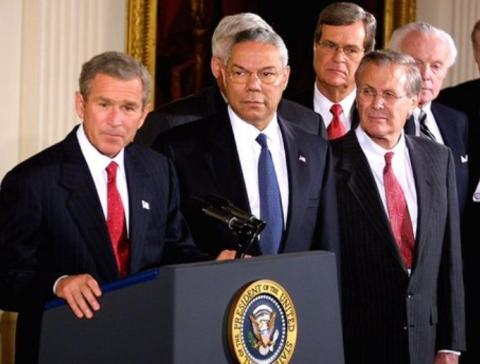
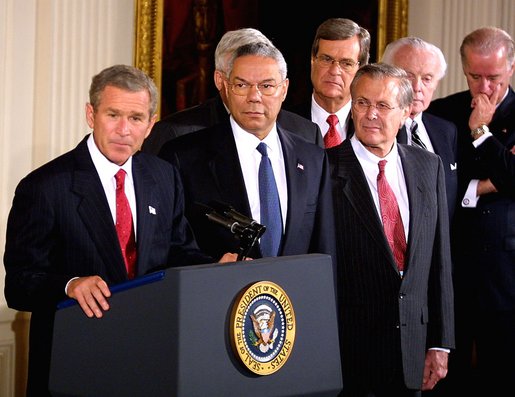
    This is all certainly insufficient. A “sufficient” response would be a Church-committee-like Congressional investigation of the war and its supporters. This would be followed by legal authorization of lawsuits against the personal property and estates of government officials who prosecuted the war. This would be followed by a tidal wave of lawsuits by maimed soldiers and the families of Americans killed in the war. Foreigners would be able to sue in federal court, as well. George W. Bush and Paul Bremer should be facing financial ruin as should the heirs of Donald Rumsfeld and Colin Powell.

    The odds of all that happening are about zero, unfortunately.  The more attainable goal at hand, however, is to fight to ensure that the Iraq War and its supporters are never rehabilitated by historians, and the war does not go down in history as some sort of “noble but misguided” conflict. Nor should it be forgotten.

    The War’s Record of Failure 

    In the wake of 9/11, millions of Americans were primed for war with somebody—anybody—on whom could be pinned the blame for what happened that day. Although Iraq had nothing to do with the 9/11 attacks, a majority of Americans believed it did. Any remotely well-informed person knew this was not the case, but the dominant corporate media did nothing to disabuse the nearly two-thirds of Americans who believed this. Thus, an implied—but never explicitly stated—reason for the war was to combat the terrorists alleged to be within the Hussein regime. To explicitly make the case for the war, however, the US regime falsely claimed the Hussein regime possessed “weapons of mass destruction” (WMDs) it planned to use on Americans. Colin Powell lied to the United Nations about WMDs in an effort to secure international support for the US’s planned invasion. Much of the world didn’t fall for it, but many Americans certainly did. 

    The fictional WMDs were the primary justification for the war, but for foreign policy wonks, other justifications were provided as well. The “humanitarian war” myth was used in Iraq as it has been used for most wars in recent decades. The regime insisted Iraqis would be made immensely better off by the war. Further, anti-Iran ideologues pushed the war since they imagined the war could be used to turn the Iraqi regime into a client state that would allow the US to better contain Iran. 

    Some of the more dedicated prowar ideologues pushed the war as a first step in the forced “democratization” of the world. Iraq, we were told, would be a staging ground for the eventual conversion of the entire Middle East into a region of America-loving liberal democracies. As Sean Yom of the Foreign Policy Research Institute has noted, the Iraq war was part of [a] grand revolutionary global vision in which terrorism and autocracy could be wiped out while also securing access to oil and safety for the State of Israel: 

    The push for war masked a deeper bipartisan consensus that despotism in the Middle East represented an existential threat to US national interests. Dictatorships bred dissatisfied citizens that could be seduced by the propaganda of terrorist organizations; and friendly democracies, not rapacious autocracies, could be better entrusted with protecting Israel and safeguarding regional oil. Thus, a simplistic logic reigned. If the United States could engender a wave of Middle East democratization, then grateful peoples and the new governments they elected would gladly help satisfy its long-term goals. Such democracy promotion required new diplomatic and economic commitments, such as pressuring governments to curtail repression, ramping up assistance to civil society, and conditioning aid on democratic reforms. 

    But the keystone was always war. The invasion of Iraq enshrined not just America’s coercive firepower but also the credibility of its liberal commitment. If a post-Saddam Iraq became a shining exemplar of US-built democracy, then every future call for freedom would carry an interminable clause: Democratize, or else we will do it for you.

    By these standards, the Iraq War failed in every respect. Obviously, it had nothing to do with 9/11, and thus did not punish any of the perpetrators of terrorism on American soil. Most 9/11 terrorists, after all, had origins within the US regime’s ally Saudi Arabia. The WMD’s did not exist, and thus the war did not protect any Americans from them. Moreover, the post-war Iraq regime is more supportive of the Iran regime than was the Hussein regime. Iran benefited from the fall of Saddam Hussein. On the humanitarian front, the Iraq war was a mixed bag, at best. The US’s callous and incompetent approach to the occupation involved completely disbanding the army which was responsible for keeping domestic civil order and which also offered employment to millions of Iraqis. The subsequent mass unemployment and domestic disorder paved the way for civil war and insurgencies against the United States which also “sucked thousands, if not tens of thousands, of jihadi terrorists into the country.” This laid the groundwork for the rise of the so-called Islamic State which swept across northern Iraq in 2014. Those Iraqis who actually survived the American war there now live in an Iraq that is significantly poorer than before the war. 

    As far as the plan to democratize the world goes, that’s a complete failure too. No reasonable person still believes that the United States can swoop in and turn countries into liberal democracies with a “quick and easy” war. That was never anything more than a fantasy among neoconservatives and their allies in the US regime. 

    Throughout it all, the cost to taxpayers has been at least 1.5 trillion, and if we count future costs of medical care for veterans, it comes to more than 2.5 trillion. Americans are also still paying interest on the enormous debts incurred to finance the war. 

    It’s all been such a failure that even its most dedicated supporters don’t even pretend it was a success anymore. Tucker Carlson has fully recanted his earlier warmongering. Perhaps no pundit was more rabid in his support of the war than Max Boot, and even Boot now admits he was wrong, although he couches his “apology” mostly in a book attacking his current enemies in the GOP. Sentiment against the war has even forced George W. Bush to say he “regrets” the war was based on lies—i.e., “flawed” US intelligence on WMDs—although he still can’t bring himself to actually apologize for ordering the war. Before his death, Colin Powell admitted he lied about WMDs and said he regrets helping start the war. 

    The War’s Criminality 

    Note that most of this debate ignores the criminality of the war, and the widespread human rights abuses that were both directly and indirectly due to the war. The US regime has even tacitly admitted its agents would be found guilty of war crimes were it subject to international tribunals. This is why the US has always refused to participate in the International Criminal Court treaty. This was recently brought to the fore again when the US government was asked to help the ICC prosecute Vladimir Putin over war crimes allegedly committed in the Ukraine War. The US has refused because “the [US] defence department is firmly opposed on the grounds that the precedent could eventually be turned against US soldiers.”

    Indeed, the US has long opposed the ICC. As reported by The Hill: 

    [T]he US maintains that no US official is subject to the ICC. Why is this? Because the US knows that if its were held to the same standards as Putin, the US officials would likely be charged as war criminals by the ICC. 

    The US, of course, claims to be the arbiter of a “rules-based international order,” yet it is apparent the US invasion of Iraq violated the very standards of national sovereignty that the US now invokes as the foundation of its case against the Russian invasion. 

    To illustrate the true brutality of the US war, we could point to the deaths of hundreds of thousands of Iraqis, the leveling of Fallujah, the use of depleted uranium on civilians, and the admitted war crimes committed by US soldiers and US-paid mercenaries. 

    This aspect of the war is rarely mentioned even by those who now disavow their former support. It’s easy to see why. Now that the war’s failures are obvious, the human rights abuses that occurred under the US’s watch appear all the more pointless and gratuitous. 

    The Revisionist Imperative 

    It is important to reiterate the moral and practical failures of the war because the debate over the war is far from over. 

    Although opinion has overwhelmingly turned against the war for now, it still has its defenders. Victor Davis Hansen, for example, continues to make excuses for the war and has switched to a morally questionable consequentialist claim that some “positive outcomes” from the war justify the lies and carnage. A survey of US senators shows that certain GOP partisans still defend the war: Senators Marco Rubio, Chuck Grassley, and Thom Tillis all apparently believe the war was worth it. 

    Just because scholarship on the war has turned against the war today, however, doesn’t mean this can’t change. Historical narratives on wars often swing back and forth over time. As historian Hunt Tooley has pointed out, historical debates about long-over wars continue for decades. Moreover, since the general public rarely reads serious history books, the popular interpretation of the known historical facts can always be twisted or rewritten to reflect current political goals and narratives. 

    Thus, it remains important to not let up on condemnations of the war and those who supported it. It was a failure in every way. It sowed the seeds of further terrorism and violence. It plunged the US even deeper into debt and inflationary spending. Above all, the war’s failures must be remembered the next time the regime tells us it needs yet another war to punish evil and “keep us safe.”

    Originally published at Mises.org. Ryan McMaken is executive editor at the Mises Institute. Ryan has a bachelor’s degree in economics and a master’s degree in public policy and international relations from the University of Colorado. He was a housing economist for the State of Colorado. He is the author of Breaking Away: The Case of Secession, Radical Decentralization, and Smaller Polities and Commie Cowboys: The Bourgeoisie and the Nation-State in the Western Genre.

    Image source: Wikimedia

  • The CBC Should Absolutely Be Defunded. But Let’s Do It for the Right Reason

    Patrick Carroll – May 22, 2023

    Established in 1936, the Canadian Broadcasting Corporation (CBC) is Canada’s national radio and television broadcaster. The organization provides news and media broadcasts across the country and has been an iconic part of Canadian culture since its inception. It’s official mandate is “to inform, enlighten and entertain; to contribute to the development of a shared national consciousness and identity; to reflect the regional and cultural diversity of Canada; and to contribute to the development of Canadian talent and culture.”

    Though the CBC has enjoyed wide support from Canadians for most of its history, it has faced growing opposition in recent years for taking a distinctly leftward political slant, among other things. Pierre Poilievre, the leader of the Conservative Party of Canada, has been at the forefront of this opposition, and he is actively pushing to have the CBC defunded.

    A couple weeks ago, Poilievre discovered an opportunity to further this cause. Noticing that Twitter was identifying certain accounts as “Government-funded media,” he wrote a letter to Elon Musk on April 11 asking if Musk would apply this label to CBC’s Twitter accounts—purely in the interest of transparency, of course.

    “We must protect Canadians against disinformation and manipulation by state media,” Poilievre wrote on Twitter, sharing a picture of the letter. “That is why I’m asking @Twitter @elonmusk to accurately label CBC as ‘government-funded media’. It is a fact. And Canadians deserve the facts.”

    On April 16, much to the chagrin of the CBC, Elon Musk obliged. Poilievre, for his part, declared victory. “CBC officially exposed as ‘government-funded media’,” he tweeted. “Now people know that it is Trudeau propaganda, not news.”

    But the fun was just getting started.

    Later that day, the CBC pushed back with some tweets of its own.

    “Twitter’s own policy defines government-funded media as cases where the government ‘may have varying degrees of government involvement over editorial content,’” it wrote in a statement, “which is clearly not the case with CBC/Radio-Canada. CBC/Radio-Canada is publicly funded through a parliamentary appropriation that is voted upon by all Members of Parliament. Its editorial independence is protected in law in the Broadcasting Act, as we said in our statement from last week.”

    The next day, April 17, the CBC announced it would be leaving Twitter, at least for the time being. “Our journalism is impartial and independent. To suggest otherwise is untrue. That is why we are pausing our activities on @Twitter,” it said.

    In a tweeted news report about the CBC’s departure, the page T(w)itter Daily News noted that there was a dispute over the accuracy of the label, since only about 70% of the CBC’s funding comes from the government, the rest coming from advertising. “The @CBC argues that it funds the other 30% on its own so it should NOT have the label,” they wrote.

    Less than two hours after that tweet, CBC’s profiles had been updated to say “70% Government-funded Media.” “Their concern has been addressed,” Musk tweeted.

    But then, well, this happened.

    “There. Now everyone is happy,” Poilievre quote tweeted in response.

    The Defunding Debate

    Unsurprisingly, the backlash was swift. Progressive pundits condemned Poilievre’s comment about “Trudeau propaganda” in particular, with one journalist writing that it was a “craven attack on the truth, democracy and accountability.”

    Prime Minister Justin Trudeau also weighed in on the story in a press conference. “I think it is telling that in order to attack this institution that is important for many, many Canadians, he runs to American billionaires,” said Trudeau. “The fact that he has to run to American billionaires for support to attack Canadians says a lot about Mr. Poilievre and his values.”

    In the following days, debate erupted on Twitter about whether the CBC can truly be considered “independent” media if it gets 70—sorry, 69 percent of its funding from the government.

    On April 20, the labels were removed with no explanation from Musk.

    The broader debate about defunding the CBC has of course also gotten more attention. Proponents of maintaining government funding for the CBC say it is an important cultural institution and that many small communities would not have local news coverage if not for its presence. They feel it is a reliable source of news and media that provides good value to Canadians.

    The arguments for defunding the CBC are varied, and this gets to the crux of the issue. While the CBC should absolutely be defunded, the reasons many people give for this move reveal some problematic underlying paradigms.

    Some people, for instance, just want to defund it because it’s the CBC and they don’t like the CBC. Maybe they think it’s biased journalism, and the government shouldn’t be supporting that kind of journalism. Or maybe they point to the $1 billion annual price tag and argue the CBC is just too expensive.

    Broadly speaking, the concerns behind these arguments are about quality and cost.

    The problem with these arguments is that they are too narrow. The implication is that this specific national broadcaster is poorly run, so it should be defunded. But there’s no condemnation of national broadcasters as such.

    Thankfully, some go a bit further. For example, the defund-the-CBC petition that the Conservative Party is circulating talks about the need to “ensure a free and competitive press in the Canadian media landscape.” Reading between the lines, it seems as though the Conservatives are taking a stand against national broadcasters as such, and not just exceptionally biased and inefficient ones.

    If this is truly their position, then the Conservatives deserve some credit. But there’s an even better argument they could be making.

    The Better Reason for Defunding the CBC

    The best argument for defunding the CBC is the basic moral principle that people should not be forced to fund things they disagree with. Even if the CBC were completely fair in its journalism and a fraction of the cost, it would still be wrong to make people fund it, because making people fund things they don’t want to support is simply wrong. Even if it had no impact on a free and competitive press, compelled support would still be immoral.

    The reason the Conservatives don’t use this line of reasoning is obvious. If they did, they would have to abandon their entire political platform. Almost every government initiative, after all, involves forcing unwilling benefactors to fund things they don’t approve of.

    But this is no reason to abandon the principle in favor of the platform. On the contrary, it’s a great reason to abandon the platform in favor of the principle.

    In her book Healing Our World: In an Age of Aggression, research scientist and author Dr. Mary J. Ruwart candidly highlights the problem with the status quo.

    “Through taxation, pacifists are forced at gunpoint to pay for killing machines; vegetarians are forced at gunpoint to subsidize grazing land for cattle; nonsmokers are forced at gunpoint to support both the production of tobacco and the research to counter its impact on health. These minorities are the victims, not the initiators of aggression. Their only crime is not agreeing with the priorities of the majority. Taxation appears to be more than theft; it is intolerance for the preferences and even the moral viewpoints of our neighbors. Through taxation we forcibly impose our will on others in an attempt to control their choices.”

    If freedom means anything it means the right to withhold our funds from the causes and initiatives we’d rather not support. It’s not just about having a free press. It’s about letting people decide for themselves how their money is spent, both in the media and everywhere else.

    Originally published at Fee.org. Patrick Carroll has a degree in Chemical Engineering from the University of Waterloo and is an Editorial Fellow at the Foundation for Economic Education.

    Image Credit: SimaGhaffarzadeh – Pixabay

  • Thanks to Sanctions, The US Is Losing Its Grip on the Middle East

    Ryan McMaken – May 21, 2023

    On Friday, members of the Arab League welcomed the Syrian regime back to the organization. Representatives from several Arab member states shook Syrian leader Assad’s hand and gave him, a “warm” reception according to several news outlets. Syria was suspended from the league in 2011, but on May 7 in Cairo the league agreed to reinstate the Assad regime. 

    This represents a reversal from years of isolation placed on the regime, and a break with US policy which remains staunchly opposed to Assad. Indeed, the League’s rapprochement with Assad should be seen as a repudiation of US policy, and especially as a sign of how Washington’s influence among Leage members—the most powerful of which are Saudi Arabia and Egypt—has waned.

    Moreover, this is just the latest bad news for Washington’s influence in the region coming mere weeks after Iran and Saudi Arabia re-established diplomatic relations.

    In both cases, we find regimes that Washington had sought to isolate and sanction, but both states have instead been expanding their relations with other states in the region with the help of China. Meanwhile, both Beijing and Riyadh have increased their ties with Russia. These development[s] help illustrate how growing US attempt[s] to impose—or threaten to impose—hard line sanctions against a growing number of regimes has only accelerated a global movement away from the US dollar and away from Washington’s orbit. 

    Saudi Arabia Increasing Ties with Iran and Syria

    In March of this year, Saudi Arabia and Iran announced a resumption of relations following a deal brokered by China. The Saudi regime—a longtime Washington ally—had apparently not told the Biden administration of the meetings with Iran and China. Shortly after the agreement was announced, the administration dispatched CIA Director William Burns to Saudi Arabia where he reportedly “expressed frustration with the Saudis,” telling “Saudi Crown Prince Mohammed bin Salman that the U.S. has felt blindsided by Riyadh’s rapprochement with Iran and Syria.”

    Although the White House now claims to be supportive of the new agreement between Riyadh and Tehran, this support is really just an admission that there’s not much Washington can do about it. After all, for decades, US policy has been to isolate Tehran and in recent years, Washington has imposed harsh sanctions, including Donald Trump’s “maximum pressure campaign” designed to cripple Iran even more. The Biden administration took no significant steps to reverse the Trump position. The Saudi regime’s newfound openness to Iran is thus contrary to US policy, and it is not plausible that Washington is in any way pleased with the change. 

    From Washington’s perspective, the situation got even worse this month when the Arab League re-admitted Syria, also apparently without consulting Washington. Since 2011, the US has imposed draconian sanctions on Syrian in a manner similar to Iran. Syria’s newfound re-integration into the Arab League is thus also contrary to the US’s ongoing efforts to isolate the Assad regime which the US has repeatedly claimed must by subjected to “regime change.” 

    Growing Ties with Russia

    New overtures by the Saudis toward both Syria and Iran also run afoul of Washington because both Iran and Syria are important allies of Moscow. With the US now inflicting harsh sanctions on the Russian regime, anything that helps Damascus and Tehran has the potential to help Moscow as well. 

    Both the Saudis and the Chinese have shown growing efforts to forge ties directly with the Russian regime as well. At a Chinese-Russian summit in February 2022, both regimes stated they plan to forge even closer ties. This has apparently not changed even after a year of heightened hostilities from the US and NATO aimed at Moscow. In fact, it is likely that Russia-China relations are closer than they’ve ever been in the post-Soviet era. This has clearly been a problem for Washington as China continues to provide an important market for Russian exports in the face of US sanctions. Both states have also made efforts to move away from the US dollar and settle international trade in other currencies. 

    This might all be dismissed as the scheming of foreign powers that were never reliable “partners” or allies of the US in the first place. But Saudi Arabia is another matter, and the Saudis are apparently willing to play nice with the Russians, Chinese, and other members of the latest supposed “Axis of Evil.” 

    The Saudi regime has grown closer to Moscow in the wake of US sanctions against Russia. For example: 

    Saudi Arabia and the UAE, traditional Middle Eastern allies of the United States, are not shying away from importing, storing, trading, or re-exporting Russian fuels despite American efforts to persuade them to join a crackdown on Russian attempts to evade the Western sanctions on its oil.

    In other words, US efforts to get the Arab world to isolate Russia are failing, and Russian ties with the Middle East are actually improving. 

    This can be seen in the fact that the Organization of the Petroleum Exporting Countries (OPEC)—which is dominated by its largest producer, Saudi Arabia—has shown no interest in helping the US in its sanctions war against Russia. Instead, OPEC has cut production levels to raise oil prices, which benefits Moscow. The US has opposed these cuts, and now some anti-Russia factions in the US are exploring ways to punish OPEC for its lack of enthusiasm in cooperating with US efforts against Russia. 

    At this point, a trend has clearly emerged: as the US further attempts to tighten its geopolitical grip on the global economy through economic sanctions, fewer and fewer states worldwide appear interested in playing along. 

    Indeed, the spread of US sanctions provides good reason for other regimes to increase efforts to forge close ties with other regimes as insurance against becoming the victims of US policy. After all, the US has been quite free and easy with threatening “uncooperative” countries with so-called secondary sanctions as a punishment for doing business with states like Syria and Russia. The US has been explicit in this and in February, as CNN reported at the time, “the United States is ramping up efforts to choke off Russia’s economy and it has set its sight on the Middle East. … A top US Treasury official arrived in the United Arab Emirates (UAE) on Monday to warn the regional business hub that helping Moscow evade sanctions wouldn’t be without consequences.” China had already been “warned” in a similar fashion. 

    Yet, it appears that the US’s ongoing sanctions war against a growing percentage of the world population is having the opposite of its intended effect. The US threatens to sanction Saudi Arabia and China, and in return, both countries become even more willing to seek cooperation with some of the regimes Washington has attacked the most.

    While Washington pursued a divide-and-conquer strategy throughout the Middle East, Beijing brokers deals to increase regional stability. While the US ratchets up efforts to isolate its many enemies, the Chinese, the Saudis, the Arab League, and OPEC all shrug and look to increasing international communication and trade.  The Washington foreign policy establishment shows few signs that it is even noticing. The US regimes foreign policy “tool box” continues to be centered on sanctions, violence, and making demands on both its allies and its professed enemies. The rest of the world is moving on, however, and Washington may be among the last to accept the new reality.

    Originally published at Mises.org. Ryan McMaken is executive editor at the Mises Institute. Ryan has a bachelor’s degree in economics and a master’s degree in public policy and international relations from the University of Colorado. He was a housing economist for the State of Colorado. He is the author of Breaking Away: The Case of Secession, Radical Decentralization, and Smaller Polities and Commie Cowboys: The Bourgeoisie and the Nation-State in the Western Genre.

    Image source: Adobe Images

  • Two New Medical Studies Show How Mask Mandates Failed—and May Have Harmed Countless People

    Jon Miltimore – May 17, 2023

    I have a friend, a very smart fellow, who early in the pandemic began masking. At the time, masks were not being recommended by health authorities, let alone mandated.

    I didn’t think much about his decision. It didn’t affect me. I was what you might call a mask agnostic. Perhaps masks were beneficial, perhaps not.

    As the pandemic continued, however, I found myself more and more in the “anti-mask camp.” I didn’t suddenly begrudge my friend or think he was a fool for masking, but I was bothered that personal decisions had become public decisions.

    To make matters worse, a kind of mask dogma had taken hold. To publicly question the benefits of masking or point out possible adverse effects was verboten, a crime punishable by social media bans or blacklisting from fact-checkers. (This didn’t stop me from writing about masks—see here, here, and here—but I was very, very careful when doing so.)

    Like most people, I didn’t know how effective masks were in preventing the spread of Covid. I did have doubts, however, doubts that were supported by an abundance of scientific research and public health experts.

    Just as importantly, as a student of economics, I understood that all actions come with tradeoffs. (Some public health experts learned this lesson the hard way.) What were those tradeoffs? And who could determine if the public health benefit of masks outweighed the adverse consequences?

    We didn’t have much time for those questions in 2020, in large part because few people wanted to consider them. The public health bureaucracy certainly didn’t. It had its plan, and it wasn’t interested in exploring science that might undermine their directives. Three years later, however, research has emerged that helps answer these questions.

    A study published earlier this month in Frontiers in Public Health conducted a systematic review of more than 2,000 studies on the adverse effects of masking, finding “significant effects in both medical surgical and N95 masks.”

    As one might expect, covering the breathing orifices of humans for long periods of time carries health consequences, among them decreased oxygen saturation and increases in heart rate, blood pressure, blood-CO2 levels, and skin temperature, as well as dizziness, speech impediments, headaches, and dyspnea (labored breathing).

    Study authors said it was imperative that these findings are considered in future public health policies.

    “Face mask side-effects must be assessed (risk-benefit) against the available evidence of their effectiveness against viral transmissions,” the authors concluded. “In the absence of strong empirical evidence of effectiveness, mask wearing should not be mandated let alone enforced by law.”

    We now know some of the negative consequences of masking (and mask mandates). But what about their effectiveness in reducing the spread of Covid?

    As it happens, a massive study conducted in the UK, which examined one of London’s largest hospitals for 10 months during the highly contagious Omicron variant, sheds new light on this question.

    Though the full research has yet to be published (it will be presented at the 2023 European Congress of Clinical Microbiology & Infectious Diseases in April, officials say) study authors make it clear that the hospital’s masking requirement made “no discernible difference.”

    “Our study found no evidence that mandatory masking of staff impacts the rate of hospital SARS-CoV-2 infection with the Omicron variant,” said lead author Dr. Ben Patterson of St. George’s University Hospitals NHS Foundation Trust, London.

    “The bottom line is that lifting the hospital mask mandate did not lead to a measurable increase in hospital-acquired COVID infections,” Jeanne Noble, associate professor of Emergency Medicine at the University of California, San Francisco, told Healthline, adding that the research was more robust than previous observational trials.

    In other words, the two most recent studies on masking suggest masks were terribly ineffective in reducing the spread of Covid, but came with clear health harms. Yet countries across the world and states across the US were mandating their use for months if not years.

    How does something like this happen? Economics holds a clue.

    In his 1974 Nobel Prize speech, F.A. Hayek talked about the dangers of acting with “the pretense of knowledge.” In some ways, this knowledge was worse than no knowledge at all, because it stood to lead government officials and experts to believe they possessed sufficient knowledge to engineer society successfully.

    As many have noted, history has shown that Hayek was right to be worried. And for decades historians and economists have highlighted Hayek’s warning about this “fatal conceit” rooted in the pretense of knowledge, stressing the importance of demonstrating “to men how little they really know about what they imagine they can design.”

    Fewer, however, have noted a separate paragraph from Hayek’s speech, in which he notes what drives public officials to act with insufficient knowledge.

    “The conflict between what in its present mood the public expects science to achieve in satisfaction of popular hopes and what is really in its power is a serious matter because, even if the true scientists should all recognize the limitations of what they can do in the field of human affairs, so long as the public expects more there will always be some who will pretend, and perhaps honestly believe, that they can do more to meet popular demands than is really in their power.”

    This paragraph perfectly describes the phenomenon witnessed during the pandemic.

    Public officials clearly did not have enough knowledge to make rational decisions for hundreds of millions of Americans. But they had to pretend they did (and perhaps some actually believed they did, as Hayek suggests) because that was the popular demand. Influential conservatives and progressives both largely bought into the fiction that public health officials could rationally plan society—through mask mandates, lockdowns, and social distancing—to protect humans from the coronavirus.

    The pandemic was not just a failure of science. It was also clear evidence that government, freed from its constitutional and rational limitations, has grown far too large, as have our expectations of it.

    Originally published at Fee.org. Jonathan Miltimore is the Managing Editor of FEE.org. (Follow him on Substack.) His writing/reporting has been the subject of articles in TIME magazine, The Wall Street Journal, CNN, Forbes, Fox News, and the Star Tribune. Bylines: Newsweek, The Washington Times, MSN.com, The Washington Examiner, The Daily Caller, The Federalist, the Epoch Times. 

    Image Credit: iStock

  • Could the Entire Banking System Come Tumbling Down?

    Walter Block – May 11, 2023

    How does one describe our present banking system?

    It is like an upside-down pyramid, with the tippy top of it located at the bottom and the widespread base of it placed at the top. If even a slight wind comes along, it will knock down the entire enterprise. The bigger they are, the harder they fall. Heck, you don’t even need a breeze. This enterprise is as unstable as it conceivably can be.

    It is like a man wearing 10-inch high-heeled shoes. You look at him crossways, and he’ll fall down (women have far more practice at wearing such shoe-wear). You need not look at him at all and he’ll collapse.

    It is like a little kid getting on a bike for the first time, with no training wheels. It is like someone’s first run on stilts. It is like riding a unicycle for a trial run. It is like the first try at tightrope walking.

    Are you getting my drift? The banking system is teetering and tottering. Why is this?

    It is due to the fact that it engages in fractional reserve demand deposit banking.

    What’s that? Mr. Apple comes to a bank and deposits $100. The bank gives him a demand deposit for that amount of money. What does that mean? It means that A has the right to withdraw up to that amount, $100, any time he wants to (assuming the bank is open) or write a valid check for that amount at all times, and the bank is legally obligated to honor it.

    What, then, does the bank do with this money? Assuming a 10% reserve ratio, it lends out $90 to Mr. Banana and keeps the remaining $10 in its vault. What does this mean? Exactly the same as before. Mr. Banana now, also, has a checking deposit with the bank; he can call up these funds of his at his own discretion, up to nine ten dollar bills worth of money.

    See the problem? The bank now has assets of $100 cash under its control (plus an IOU) and liabilities of $190. There used to be $100 in circulation, there is now $190. If Mr. Banana deposits his money in a second bank with the same reserve ratio, and continues down the line, there will ultimately be $1,000 in the economy, all pyramided on that initial $100 ($90+$81+$72+$63, etc.).

    Talk about teeter-tottering. How can all this come tumbling down? Simple. All Mr. Apple and Mr. Banana have to do is demand more than $10 of their money from the bank. The latter cannot make good on its obligations. Its bankruptcy will then become fully evident. (For more on this argument see Fractional Reserve Banking: An Interdisciplinary Perspective by Walter Block.)

    Why, then, does banking seem so stable, apart from recent occurrences with the Silicon Valley Bank? There are many reasons, but one is particularly significant.

    The Federal Deposit Insurance Corporation (FDIC) makes a highly-regarded offer to the banking public: if ever any bank under its jurisdiction cannot meet its obligations, this monetary authority will bail it out, at least to the extent of $250,000 deposits, and, as we have seen in the Silicon Valley case (home of high tech wokists), without any real upper bound. To the extent people believe in this, the system will not unravel.

    However, if there is any problem, remember, we have a teeter-totter system, and if the FDIC indeed has to step in, not as to the degree of at present (at least as of this writing), but to a far greater extent, this can set up a hyper-inflation Germany 1923 style. Then, all bets are truly off.

    My initial description of our present banking system is thus incorrect. Matters are far worse. It is not as if one unicycler, tightrope walker, upside down pyramid, or stilts walker, is in danger of taking a tumble, and pulling a few hundreds or thousands of dependents down with him. That is indeed true. But, in addition, it is as if they are all attached together by a rope, and if one of them falls, all are at risk, that is, the entire economy.

    How would banking operate if fractional reserves were banned? Simple. Banking would then be like tailoring. What does the tailor do? He does two things. First, micro, he gathers small bits of thread together to create a larger cloth. Or, second, macro, someone comes to him with a gigantic textile, and he breaks it down into smaller garments.

    So would it be with a more rational banking system. On the micro level, the banker would gather small deposits from hundreds or thousands of savers, and lend out these monies to investors on a larger scale basis. He would do all of this on a time deposit basis, so that he can be assured that if there is a demand to make good on these deposits, the bank has the wherewithal to meet all obligations.

    On the macro level, when a very wealthy depositor leaves in his care a gigantic amount of money, the banker breaks it down to smaller bits and again lends them to investors. From whence does his profit arise? Not from legalized counterfeiting, as at present. Rather, from the differential in interest rates between depositors, who he pays, and borrowers, to whom he lends.

    A third licit task performed by banks is to serve as a money warehouse. People leave their savings with the bank for safekeeping, since the banker has the strongest safe in town. But, just as you pay to have your furniture stored, the warehouse does not pay you (imagine if they lent out your furniture to others and didn’t have it available for you when you wanted it back), you pay it. So would it be with banks; you would pay them to keep your nest egg safe.

    Boring? Yes. But safe, too.

    Originally published at Fee.org.  

    Image Credit: iStock